
Airion Inc. has launched a joint project with Nagano Automation Co., Ltd., a manufacturer of production equipment, to apply AI to equipment manufacturing.
As a first step, we are embarking on the development of AI to automate ladder programming for the PLCs (programmable logic controllers) that control equipment operation. In this project, we aim to use AI to read drawing information for production equipment and automatically generate ladder programs based on that information. The goal of the project is to have AI support ladder programming in a way that follows the engineer's thinking, thereby reducing engineers' workload, saving time, and making effective use of resources.
■ Background of the AI Development
Production equipment development is inherently one-off, and the manufacturing process places a heavy burden on people. Within that process, PLC ladder programming is an indispensable technology for controlling production equipment in the manufacturing industry. However, conventional manual development takes a great deal of time to write programs, and engineers' resources are not sufficiently applied to higher-value work. Against this backdrop, Airion and Nagano Automation Co., Ltd. are working to make production equipment development more efficient and to improve its quality through AI.
■ What the AI Development Covers
Generating basic ladder programs
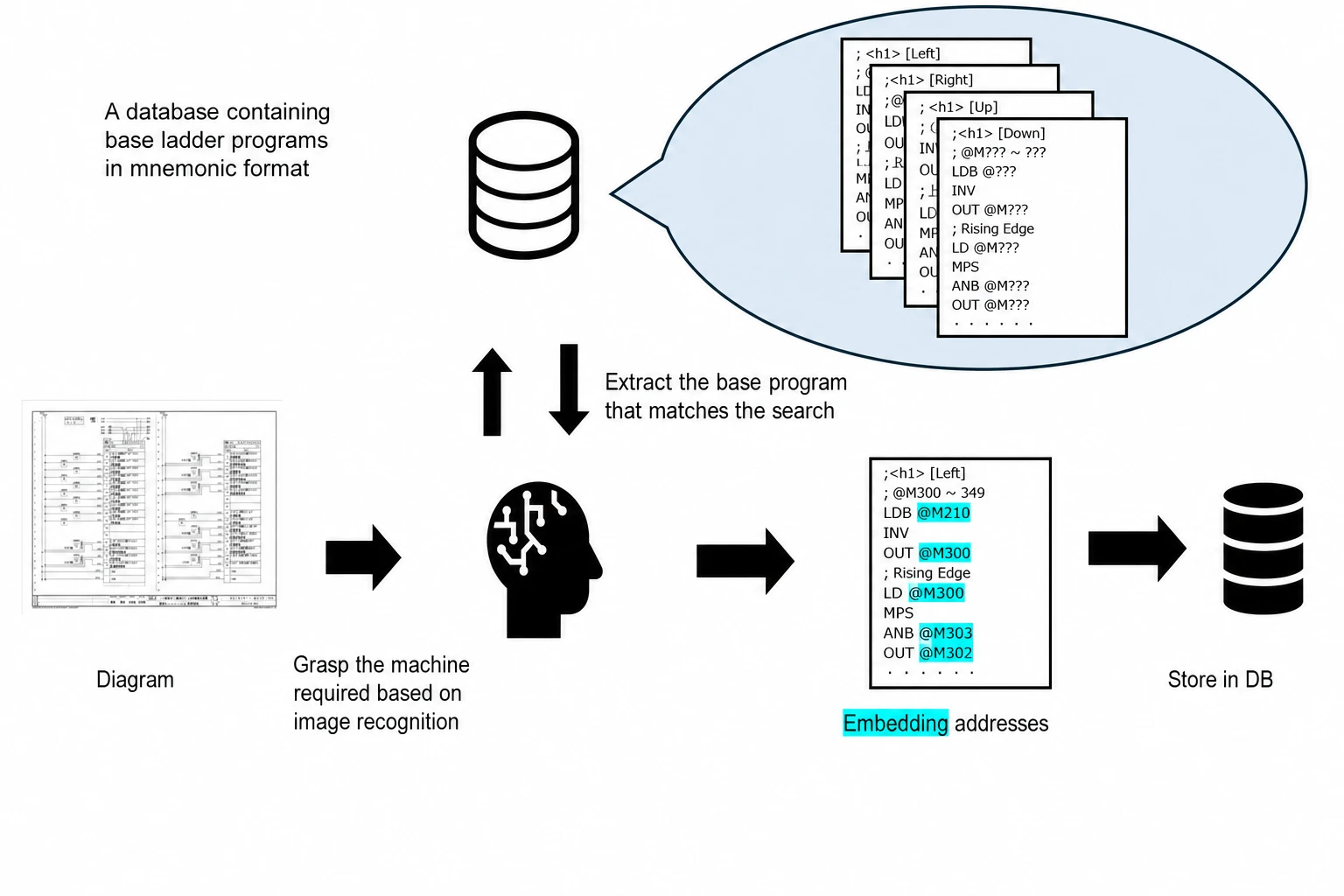
Drawing information is read by image recognition AI, and ladder programs are automatically created based on that data. The foundational portions of the ladder program are generated by extracting the relevant elements from a preconfigured database.
Generating advanced ladder programs
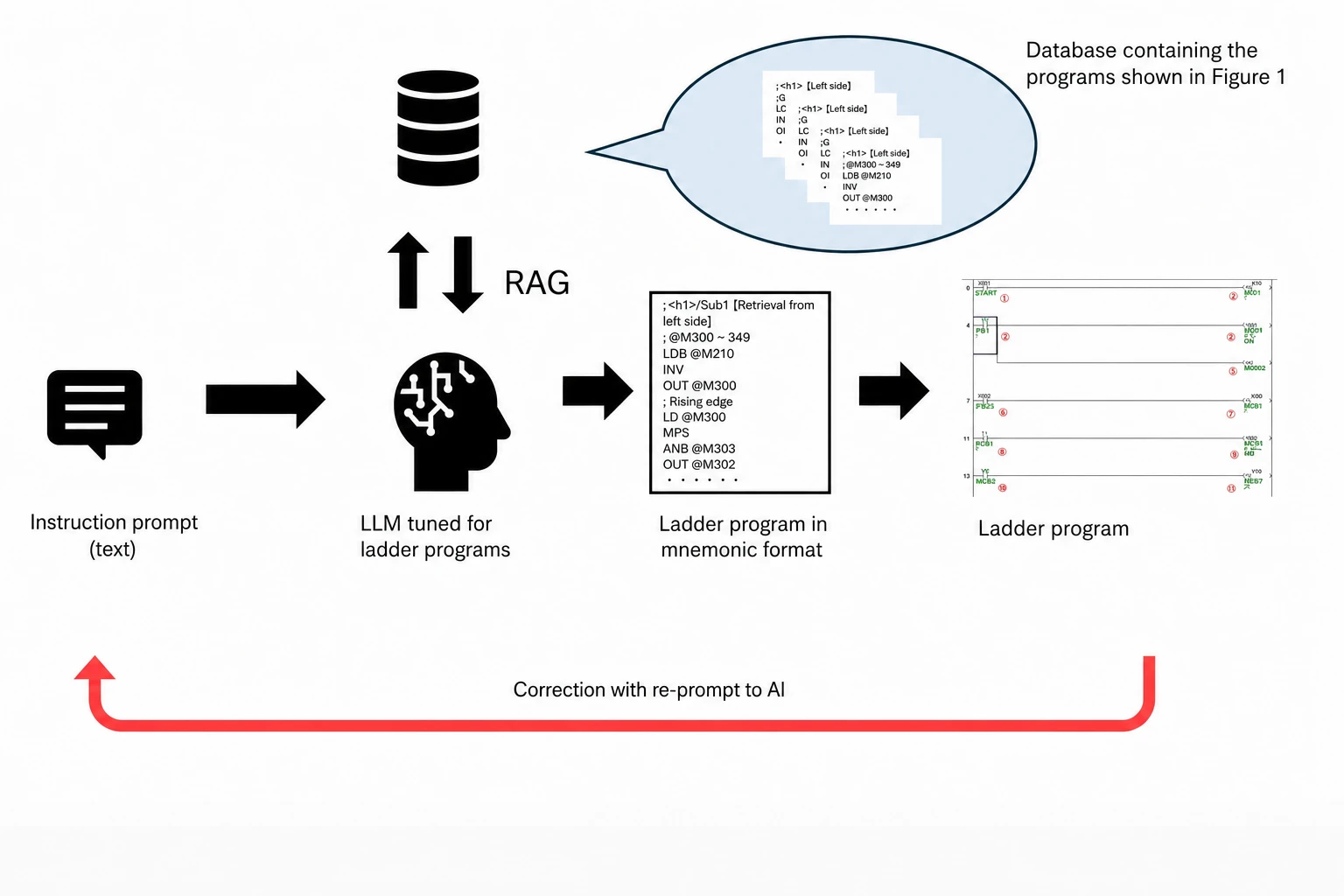
Leveraging the ladder program data already accumulated, an LLM (large language model) is used to tune the programs. This makes it possible to create highly customized programs and programs specialized for specific tasks, which is expected to reduce engineers' workload and improve work accuracy.
■ Looking Ahead
- We will continue working to improve the accuracy of the developed AI.
- We will continuously collect training data.
- We will use feedback from actual users in training.
- We plan to implement integration with dedicated PLC software.
- We will progressively expand deployment in the field, aiming for a more intuitive, user-friendly system.
- We will begin verifying AI applications in the mechanical design domain.